%20(1).png)


For the last 25 years Neil Tye has been working as a physical visual theatre performer, instructor, teacher, and installation artist, and has taken his performances and teaching skills around the world.
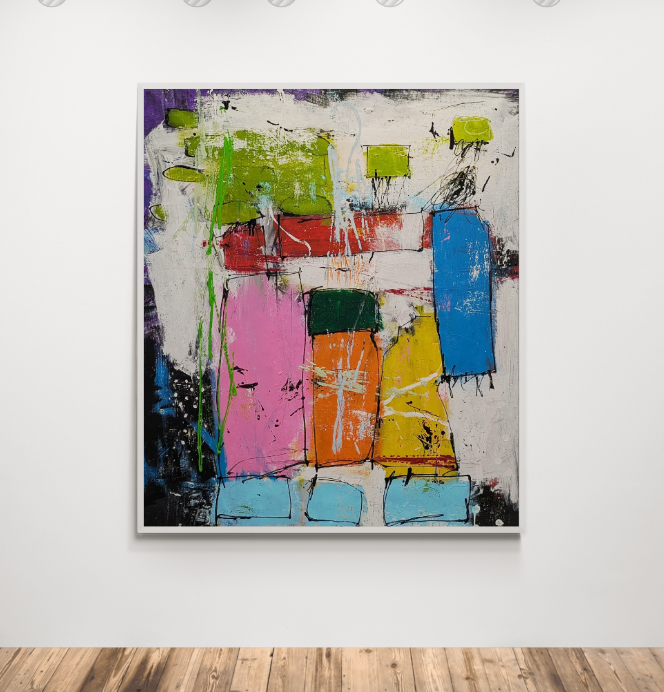
Tye is a Denmark-based artist with a background in both visual arts and physical theatre. Drawing from his multi-disciplinary background, his work explores movement, form, and storytelling through visual mediums. His practice is grounded in an intuitive and process-driven approach, wherein the act of painting itself dictates the final composition. By embracing spontaneity and fluidity, his work exists at the intersection of abstraction and interpretation, inviting viewers to engage with the imagery in a way that is both personal and open-ended. Through this interplay between process and meaning-making, his paintings function as both intuitive expressions and conceptual explorations of movement, memory, and transformation.
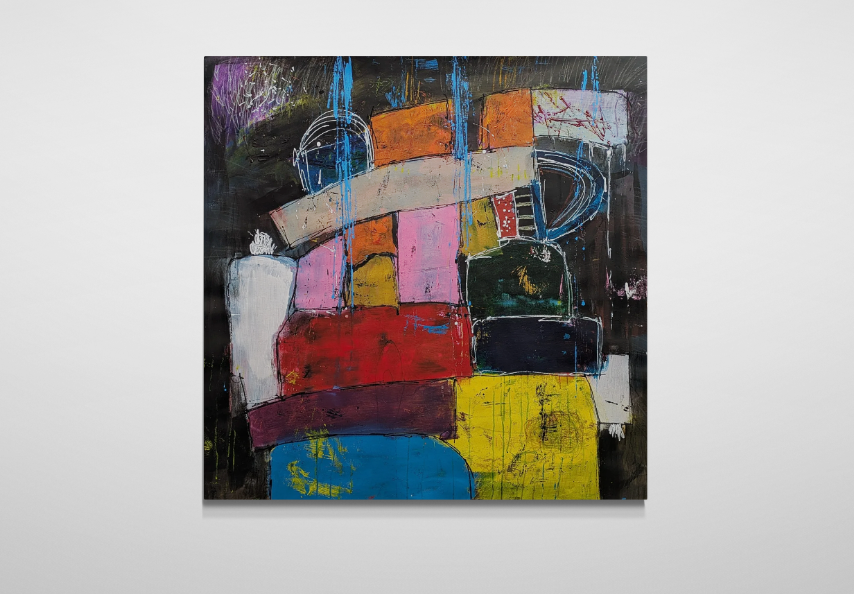
He has explained that the title of his current exhibition, The Things We Carry, seen most recently at Redbud Arts Center Houston in June 2025, “was inspired by reflections I had while creating my recent body of work. The first thought centres on the fundamental nature of human connection—we are not meant to navigate life alone. We rely on one another for support, understanding, and encouragement, whether through conversation, shared experiences, or emotional upliftment. The second thought arose from one particular painting, which evoked the image of an overloaded truck. This visual metaphor led me to consider how, in life, we accumulate and carry various burdens–emotions, worries, frustrations, memories, secrets, hopes, and dreams. These intangible, yet weighty, elements can become overwhelming, making it evident that we cannot bear them alone. At times, we must find ways to release or share these burdens, but this raises important questions: Where do we turn for relief? To whom do we entrust our heaviest thoughts? And how can we cultivate a sense of communal support to help lighten the loads we all inevitably carry?”
Tye has worked with Ad Deum, a professional modern/contemporary dance company based in Houston, Texas, directed by its founder Randall Flinn, who established the company in January 2000. The mission of Ad Deum is to create and perform excellent and vital works of dance that serve to wash over the heart and soul of humanity with relevant meaning and redemptive hope.
At Flinn’s invitation Bill Wade also became involved in a collaborative dance performance at the opening of Tye’s exhibition in Houston. Wade founded Inlet Dance Theatre in 2001 and the company embodies his belief that dance viewing, training and performing experiences may serve as tools to bring about personal growth and development. Inlet’s ensemble-based culture intentionally focuses on craftsmanship and mastery while employing a collaborative creative process in the development of new work. All of Inlet’s repertory speaks creatively about human life issues and does so in a life-giving manner. The company presents a wide aesthetic range of works that speak to what could be, rather than only what is.
I spoke to all three about their collaboration and Tye’s work.
JE: So, Neil, your arts practice has included being a physical visual theatre performer, instructor, teacher, and installation artist, as well as an abstract expressionist artist. How did this unusual combination of disciplines come about?
NT: I think it just works itself out. Art has always been part of my life, from a young age. When I was a kid, I was always drawing instead of going out and playing in the streets. I was doing still life paintings of apples and the like on the table. I just loved drawing. From a young age I knew that's what I was supposed to do.
So, I went to art college and studied art but I was also interested in a broader kind of sense of creativity. I loved music and I played in rock bands as well. I think through that you hang out with all these different artists and you get a different feel of what other people are doing. A friend of mine was going to a dance class in Camden Town and I was introduced to this dance school that was run by an old lady called Hilde Holger, who is a legendary dancer and dance teacher. She was the first person to develop integrated dance and was teaching a form of abstract dance expressionism called Central European Expressionism. I stepped into this whole new world where Hilde introduced me to a new way of looking at creativity and expression. I was just sold on it and I started to immerse myself in that world, to the point where I went to Goldsmiths University to study art in therapy.
My life took a different course while I was at that dance school. I got saved. I became a Christian and I can remember Hilde saying, ‘Now you're going to give it all up’. I said, ‘Why do you say that?’ ‘It's because you've become a Christian.’ My experience for most dancers is that, when they become Christians, they give it all up. Dance isn't accepted in the Church, although Hilde was one of the first people to actually do dance performances in the Church, with ‘The Creation of Adam and Eve’. So, she was a legend and I learnt so much from her. She opened up a whole new world to me.
I kind of left that when I went to a Bible College, to Youth With A Mission. So, it has been, always a mix of doing different creative things. I met my wife in Denmark and she was studying dance, so that whole creative thing came alive again in me. We both decided that we would go and study Physical Theatre. So, we went off to the Desmond Jones School of Mime and Physical Theatre in Shepherd's Bush and we studied under him for a long time but I always had in the back of my mind that I wanted to be a painter. I was teaching a lot with physical theatre and was working with some companies in Copenhagen. Then, I lost my job about 15 years ago and got back into art again and painting. I think it was like transferring movement from the floor onto canvas.
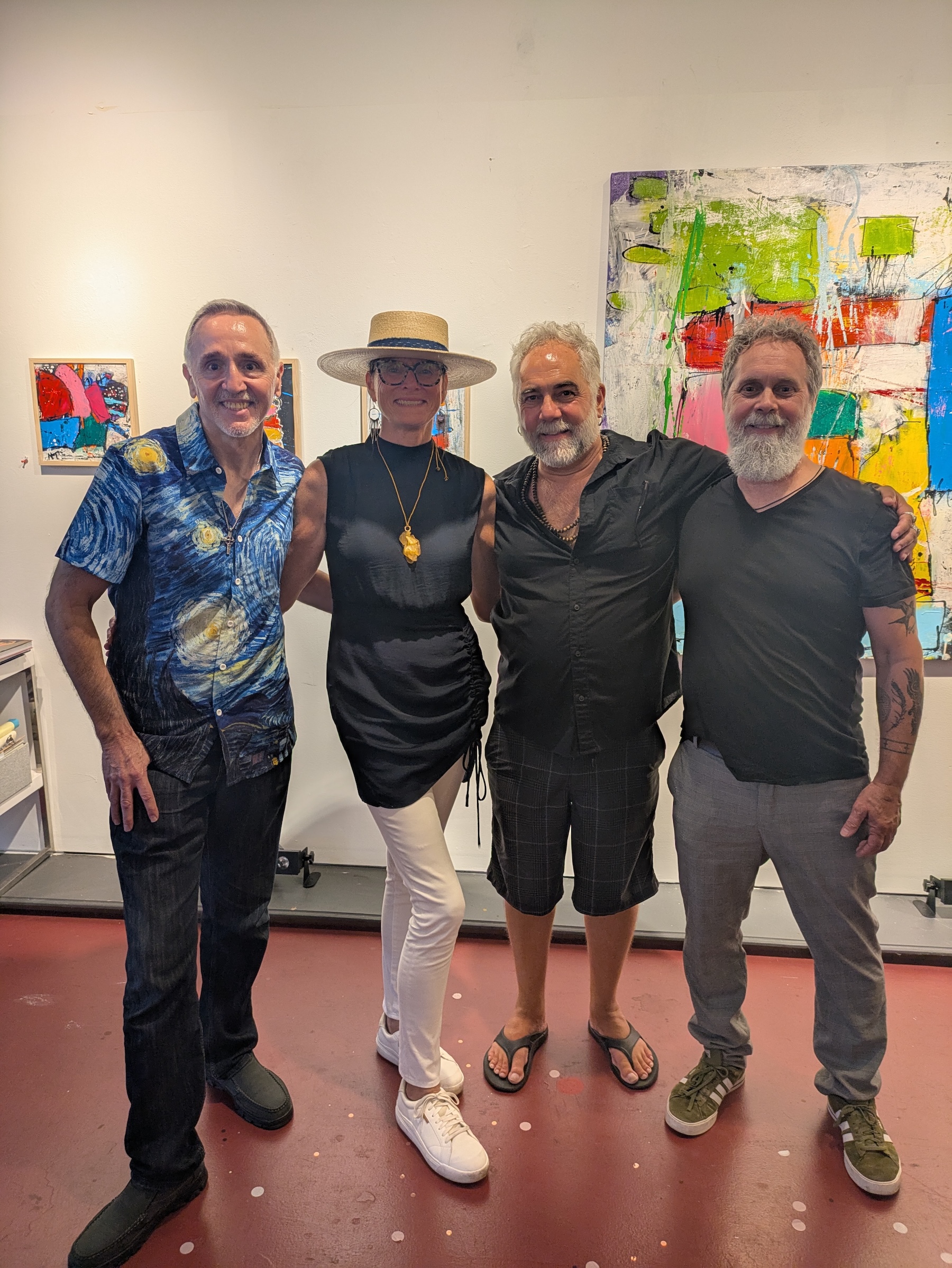
Bill did it the opposite way round to me, he went from canvas to the floor. I saw a natural progression in that. I mean, those two things are so intertwined in the way I think. What I learned with the style of physical theatre was what they call devising or improvisational techniques; doing improvisational work and then learning how to create pieces, not having a written piece to work from, but through the improvisation process finding a story in a narrative. I naturally bought that into my painting. Those two seem to go well together, especially studying under Hilde with her expressionism.
JE: How have the past 15 years built to the point of your latest exhibition and its theme of The things we carry?
NT: In those 15 years, I was doing a lot of installation art because I felt that was a step in the direction of being theatrical as well. I see installation art as being very theatrical and I was working on conceptual ideas within that. Some abstract painting is not about the concept but about the process and what you get out of that process and leaving that open for the public to be able to decide what they see. But because I've done the installation art as well, I kind of pull upon a concept as well. So, coming all the way to The things we carry, whenever I do my work, it ends up moving into a concept which can be open for other artistic forms.
JE: The openings of your exhibitions always feature a performance linked to the exhibition theme. For the first exhibition of The things we carry in Denmark you worked with theatre students from Lunderskov Efterskole and in Houston you worked with Bill, Randall, and Randall’s Ad Deum Dance Company, with whom you had worked previously. Why are such performances important to you and, Bill and Randall, how do you engage with the kind of themes that Neil's exploring in his art?
NT: I think it's important because it's part of my life. I mean, I've been doing the physical theatre and the dance for many years. Movement is what I'm interested in. It's been an integral part of my life and it is natural for me to want to see how I can link these two things together in some way, shape, or form, because I have a passion for them. I still haven't quite got it yet, but I'd love to find that real integration of abstract art and dance, and how you can really bring those two things together in a collaborative work. And we've been trying to do that together.
I think a lot of people, when they think about abstract artists, they want to actually see what they're doing when they paint because abstract art is difficult to understand in many ways. When they do actually see artists creating, they see them moving as they're engaged in the emotion that they're bringing out in their work.
BW: I grew up drawing and painting and doing sculpture but found American modern dance when I was 18 and just jumped ship completely, because I was also hyperactive. I was a gymnast when I was a kid, back flips off the garage roof and all that kind of stuff. So, my parents stuck me into gymnastics and tumbling and then when I saw modern dance, it was like I could truly be myself and do this art.
I create choreography the way that Neil does his canvases. With my dancers, I train them up, not just physically, but also to think about what's happening in this space. For me, it was a joy to play with Randall's dancers because they're so beautiful and they have all the toys that a choreographer could want. They were very, very open to my process which is quite different to what those young dancers are used to in their ballet classes and their codified modern dance technique classes. I am more of the ilk of what Neil was talking about and yet I'm also a stickler for technique.
You know what's weird about this whole situation with the three of us dudes working together? I've been following Neil's work on Instagram and Facebook for years and I finally realized he was also a believer and I was like, no way, somebody that's this good at painting is also a believer! Then Randall, who knows everybody, arranged this whole thing and I got all excited because I remembered messaging Neil well over a year ago and I was like, someday if I make a lot of money, I'm gonna buy one of your paintings. So, it was just such a joy to fly down to Houston and hang out and have Neil explain his process on the canvas, which I've known since I was a kid, to the dancers as a gateway to open up their thinking.
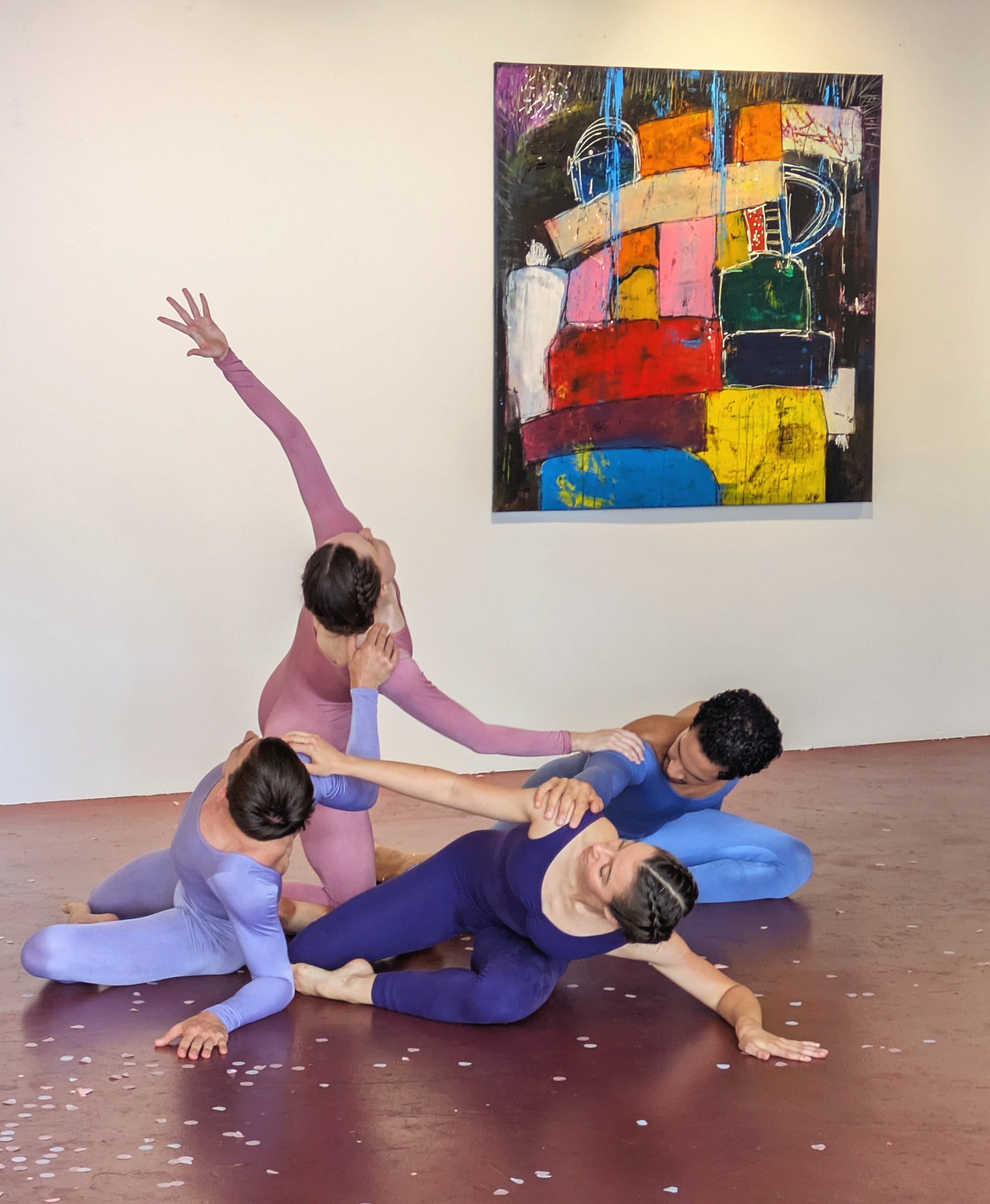
So, then I entered in and I was like, we were getting to play; taking all of the physical cues from the imagery on the finished canvases but keeping in mind the process that created those images and putting the dancers through that so they made those images with their bodies. So, we created a happening, like from the seventies, inside the gallery and it was really interesting to do that prayerfully and mindfully. To really include, in the studio and in the gallery, listening to the Holy Spirit and just facilitating, which is kind of what it feels like. The end result was there's a gallery full of people that have not yet intersected with the Lord standing there weeping at the performance. And I was like, okay, this is what happens when the Lord is allowed to move through what you're doing. You just stand back and let Him have it and he's so kind and so beautiful and so loving and so graceful and all of those things. So, Neil and I are gonna do more. We gotta figure out how, because it's just great.
RF: I think for me, I find it delightful, but I also find a sense of mission to embody meaning and believe that the embodiment actually brings forth the meaning on a deeper level; not always the rational or cognitive level, but more like opening up a window for the soul. Maybe a part of it is my own little boy Catholic background where I was enamoured by the sacraments and seeing the sacraments as an embodiment of grace.
As a believer, I came to faith at a Billy Graham crusade in 1981, here in Houston, and, outside of the traditional going to Catholic church as a child, I had no theological base. But then what I found a little bit disappointing is that in the Protestant church here in the US, especially those that tended to be more mainstream or mainline or even charismatic, the arts were regulated to, unless it was music, a very mediocre way of presentation, and they weren't looked at as being significant. They were extremely marginalized and, being a believer, I loved being involved in local church and in various capacities of ministry, but as far as a theological base for the arts went – call it poetic theology or aesthetic theology or romantic theology, whatever – it was just null and void.
And then by the grace and mercy of Jesus, the Lord sent me to Europe. In Europe, I was minding my own business performing when this lovely, elderly woman came up to me and she said, we need to have a discussion, ‘Will you meet me for lunch?’ So, I went to the cafe. This was in the Netherlands at a place called De Bron Christian Artist Seminar. She introduced herself to me, Edith Schaeffer. She had a wonderful discussion with me and she said basically you need to understand that your vocation, without any other codification, is holy to the Lord, and be careful not to live in a dichotomy between the sacred and the secular. See that the earth is the Lord's and the fullness thereof, and embrace that.
Then, of course, she turned me on to the teachings of her husband and Hans Rookmaaker and on and on and on. It just opened up my world. Although that opening of my world became frustrated when I returned to the USA, especially because I'm from Texas and Texas has a Christian culture of its own going on. Yes, for sure, I had to fight against the mentality. It wasn't a malicious mentality it was just uneducated. I think what really stirred my heart was the theological base of the incarnation. It stirred something in me; John's poetry: the Word became flesh to enflesh among us, had a local habitation, and we beheld his glory.
I'm now thinking, okay, so, Lord, maybe this is what this whole artistic thing is about as a believer. It's to embody sacramental offerings, not in a traditional way, but artistic sacraments that bring people into an encounter with beauty, with grace, with goodness, with truth. But I felt like the powers that be in the United States, especially in the South, found it very suspect for the arts to communicate theological truth. The Arts could be declarative and be hung as decorations but the true impact had to be through the preaching of the word. There were times when I would be invited to dance at a church and the pastor would say, “so, before we get into the word, we have a young man here who's going to present a dance.” And I was like, “no, I am not the half-time entertainment for the football game! Dance is also the word, but this is the word embodied and it can have a lot deeper meaning than your dry dogma and pragmaticism.”
I've known Neil since the late eighties or early nineties. I did a project with Neil before this project that Bill came in on. This particular project, when Neil was telling me the theme of the project, immediately I just felt the Lord dropped it in my heart; this is not for you, this is for Bill. I knew that, I knew. Then it was amazing that Bill and his company already had something on schedule, but it got cancelled. I initially invited Bill for a week and he said, ‘Hey man, I can do two weeks.’ And it was like, okay, Lord, you're working through all this.
When I did the first project with Neil it wasn't themed, it was just his various paintings. Then, hearing the title of his paintings and what his prophetic approach was to the paintings, my dancers and I would dialogue asking “how do we take this as an assignment to embody the vision of this artist and do it in a way that honours the artist?” And by honouring the artist, we also honour the Lord who has inspired the artist to do the work. So, then, it boils down to integrity of craft as well.
I think there's something amazing when you have music, which is extremely important for the work, the moving art, plus the dance, and it becomes like a Trinitarian fellowship. In the power of that Trinitarian expression, it became so overwhelming that I would honestly have to say without charismatic language, the presence of God was in that place. What was being expressed wasn't codified religious language, it was artistic language that God had kissed. And I think a part of it was the fellowship that we had together. I would say God commands his blessing where there's unity of the brothers, and there was complete unity.
It was a unity. There was a fellowship. We had a good time. We shared our different ways of approaching problems and to just know that we have Christ in us was testimony without actually saying any words. Allowing our craft to speak and God to speak through that craft I think perplexed people in the Gallery, but in a way that they were wanting to know more, asking questions. It was quite profound; the dancers performing and the art on the wall. They were two separate things, but they were gelling together and had their place. I don't think one was taken from the other. It was a collaboration of different crafts coming together and celebrating the gift that God has given us in a way that really connected us as brothers from far away.
BW: I was just thinking that what was really cool about this, was that it was free of propaganda. That's not what we're into, that's not part of it at all. It's like, listen to the Holy Spirit and use your craft, while being really emotionally and spiritually honest and available and in the moment. And when the Lord takes three people that are involved in craft that is very, very different and yet really similar in other ways and puts us all together, it’s because He had a moment that He wanted to have with these folks down in Houston. It was amazing.
JE: Neil, how did you all come to the theme of ‘The things we carry’ and what are some of the ways in which you have interpreted this theme?
NT: Originally it came for me through the painting that I did that started the whole series off. Because that's how I work. I produce one painting through my process and then I take a step back and I start to begin to decipher what's been made. What's it saying for me? Within that process, being a believer, I invite God. So, you know, it's a sacred place for me in my studio. We're having a conversation. We're in a contemplative state of prayer, you could say. It's a contemplative thing, what I'm doing and, in that contemplation, I look at things and things come out.
This particular painting that I finished reminded me of an overloaded truck. I've been all around the world on mission trips and I've seen a lot of poorer places where they're transporting, whether it's food or furniture, whatever it might be, and they just overload these trucks. And then I felt the Holy Spirit was saying to me, “It's just like the things that we carry.” And that was the word that came out. And I felt, okay, God, there's something in this. It's not just a material thing, it's an internal thing as well. It's something going deeper.
I felt that God was really wanting to bring that out through the art, through dance, and through painting. How do we grapple with this? It's a loaded statement, the things we carry, and I'm trying to kind of make it broad in the sense that we carry all kinds of things. It could be light things, it could be good things, it could be memories. Memory is key in a lot of my work because it's dealing with the emotions. Abstract art deals with emotions and it brings out memories and it can lead you to other places in creating something. So, that, for me, was how it was born. And then I gave that over to Randall, because I've worked with him before to see what we could do with it as regards to movement.
RF: As I looked at the paintings, especially again, with this theme of the things we carry, I realized that this would call for weightedness. There would have to be some oppositional tension. There would have to be a yielding of that tension. There would have to be a willingness to be carried. There would also have to be some apprehension in being carried.
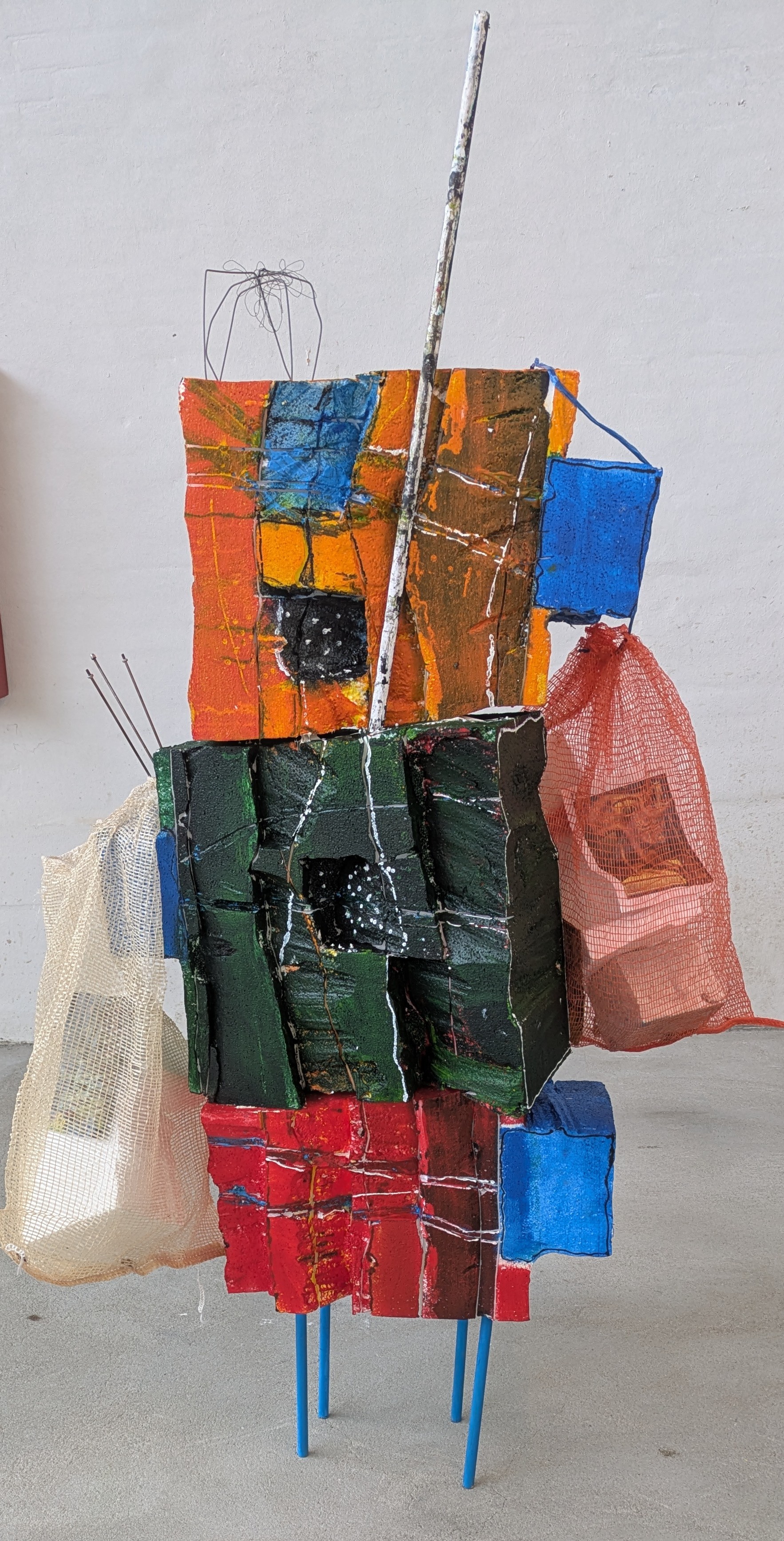
So, again, I reflected on the aesthetic of my work and Bill’s. We're both in the modern dance genre but Bill's work is much more sculpture-like because, as he says, his dancers climb on one another. I do more what I would call codified modern. I come from more of a Martha Graham background and things that are more balletic, lyrical, and beautiful. It has a sense of transcendence.
So, when I recognized the weight that was needed, then I knew this was not for me. I knew immediately that this is Bill. The important thing was that this, the visual art and the articulation of it into movement, begged to be enfleshed and needed to be enfleshed in the right embodiment. Because you can enflesh something in the wrong embodiment. So, that involved surrendering that and saying, “Okay, Bill, my dancers are your dancers for two weeks, do with them as you will.” But I knew it was gonna be completely awesome.
I think the thing that really opened my eyes during the performance is that we were dealing with a completely mainstream audience, a secular audience, and a lot of humanistic thought processes. But we all carry major baggage. We have that in common or else Jesus wouldn't have given us the invitation, “Come to me all you who are weary or burdened and I will give you rest.” I could see people being unburdened as they were experiencing this work. I'm not saying they weren't just watching. I think initially they had come as spectators but that changed as they began to watch the work. As they looked at the artwork, as they watched the movement, you could see that something was being released in their life. Like the dancers and the visual art became the mediators, like the intercessors in a way. That was such an enriching experience for me to sit back and see.
Bill, I saw you do the same. You just sat back and you just began to watch what was happening around us. And then not only could I see it, but people vocalized it in their own capability of vocalizing it. Like nobody said, ‘Oh, Jesus set me free.’ But they used other vocabulary where they had had a spiritual experience.
BW: It was beautiful. There is a point like you're saying, and you just sit back. But I think that is what we have to do with our art. There comes a point where we have to let go. Sit back, and trust God. You know, it's in his hands and the piece of work that we're doing is out of our hands. Allowing that to touch people. It's not us doing that. And that's what I felt about this particular title and concept. It got to the point where I felt God saying “It's not yours anymore. This is mine. Let me do what I need to do.” That's why I love working and giving it over to other artists to grapple with that.
NT: I think that's fascinating. I think that's going all the way to my beginning. That's probably a lot to do with my background in music and my background in movement and my background in fine arts or expression, art and abstract art. I love music and ask “How could that be interpreted with music?” I love dance. “How could that be interpreted with dance?” “How could we do that and make it more immersive for people to experience this thing that God wants to bring out?” That's the great job of an artist.
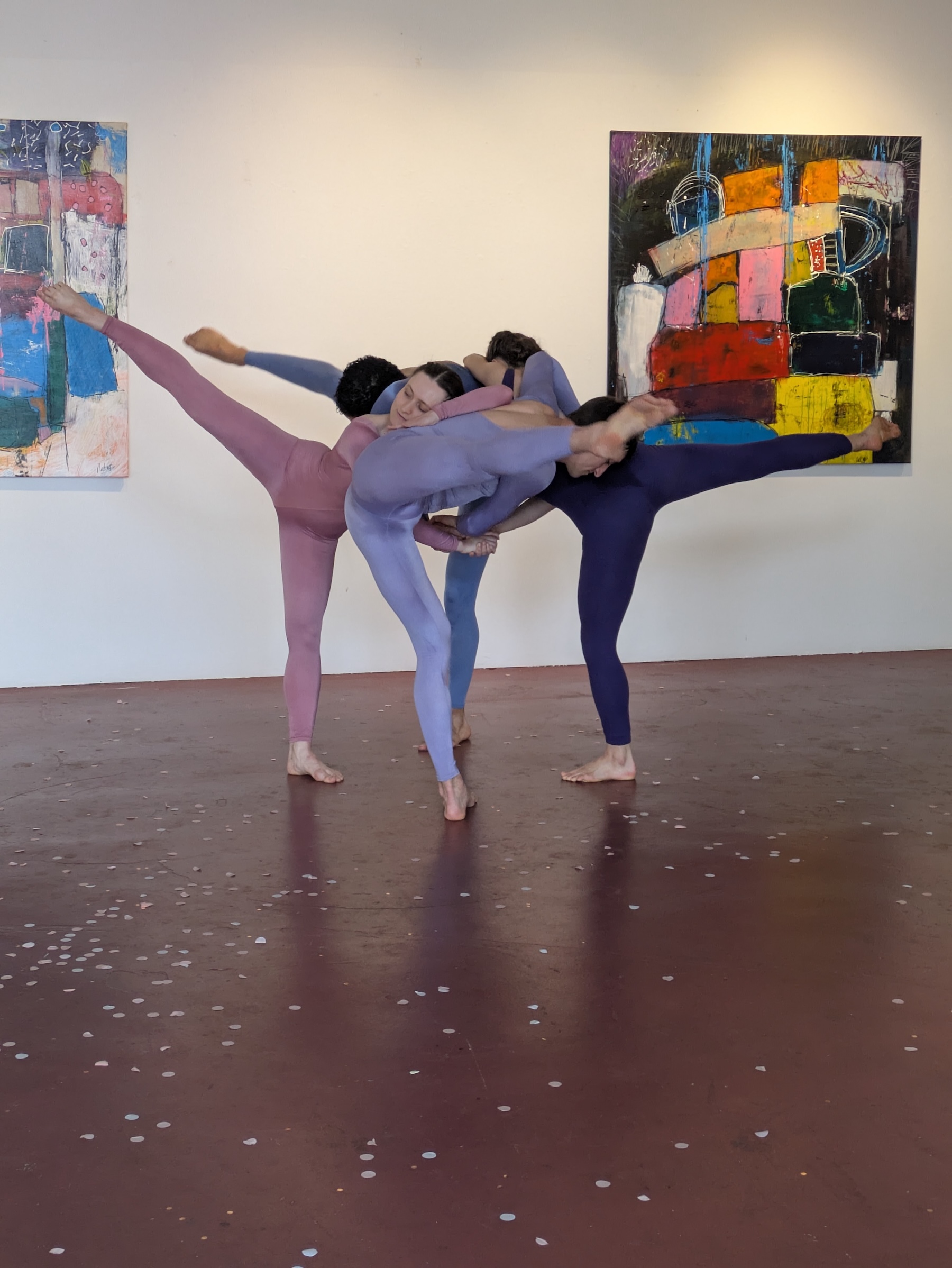
RF: One of the beautiful things was the intuitiveness of the process. It's not like you have a blueprint that's already a hundred percent perfected, you are processing as you're moving forward. And so, to see each day that Bill came in with the dancers became a workshop within itself. There were days that you thought, “Okay, where's this going?” But then Bill as an artist would reevaluate as well. He would come back home and I would hear the music playing in his room. He's going over the video of the day thinking, “Okay, I see something new in this.”
But that also takes a humility. It takes a humble spirit to sit back from your own work and go, wait a minute, I need to listen to my own work because, ultimately, it's not my own. So, I need to listen. I need to observe. I need to be a keen observer. I need to be a keen listener because I'm not the only one tweaking this.
And Bill recognizes that. He's not the only one who's saying, “Hey, let's bring some refinement here.” I think that is really a beautiful characterization of an artist who is surrendered, who is willing to, to sit back and to be still and know and listen and give time for that deep calling. We might call it inspiration, but we know where that comes from. Even in the Greek, we know where that comes from. In the Hebrew, it's ‘in-breathed’, and waiting for that breath to come, whether it's the Ruach, Elohim, or the Pneuma. We are waiting for that moment and not rushing ahead. And there were so many of those holy moments. Those holy moments are what led to the progress of the creativity. And you have to invite it too, right? You have to welcome and invite the Lord to show you what you are saying and how you can shape that so other people can see and experience what you saw.
BW: Early in the morning I would get up and do my walks and I'm texting with my composer who is back in Cleveland where I live. He is also a believer and is a pastor on the side, along with many degrees in classical music composition. We were having deep conversations about the topic and then, in rehearsals, putting these young dancers into these physical situations brought up stuff that they realized that they were holding onto. And so there was ministry inside of the rehearsals.
JE: So, Neil, this dialogue between process and intuition or inspiration that Bill and Randall have been describing, that's very much a feature of the way that you work with paint, isn't it?
NT: Absolutely. In the studio, I start just like Bill would start in the dance studio. I suppose Bill might have some kind of idea he’s working from as he doesn’t always work from scratch. He might have ideas, but I generally work from nothing. It starts with prayer. It starts with coming into the studio and being obedient to that. I know what I’m gonna be doing, which is to paint, but that might take a bit of time. I’ll sit around or just move a few things around and put a canvas up. Or if I have an old piece of work that I’m not happy with, I’ll put that back up again and say, “Right, I’ll work on this.”
But if we go all the way to the beginning of a blank canvas, then I will just start by making marks, which is very much the way I work, making marks on the canvas with a pencil, with some charcoal, whatever it might be. I’m not too fussed what I use to make those marks because they will disappear. It’s a starting point and I will then add colour. I don’t have any particular idea of what colour. I just have that intuition, “Oh, I’m going to use this.”
The process goes like this. You start a painting and you work on it, and you look at it and you say to yourself, “This is fantastic, this is great.” But you have to move on from that and it’s kind of like a life lesson. It’s so fantastic but you’ve gotta push on. So, you push on a little bit more, making more marks, making more things. And then you look at it and think, “I’m not sure where this is going.” Then you continue a little bit more and then you get to a point where you think, “Oh no, this is not good at all. This is absolute rubbish.” And we can give up in any of those moments, we could give up, but I’ve learned that with this particular process, and Bill can probably relate this, you gotta push on. You have to push on, say, “I’m not gonna give up. I’m gonna keep on going.” And then you’ll get to that point where you jump over that hurdle, and then you’ll start to look at the piece and you start to say, something’s happening.
Now I’ve moved it around. I’ve tried to find the composition and a composition will appear. And then you work on it more. And then you’ll get back to that point and say, “This is good.” And then at the end, and this is the ultimate question that most people ask, “How do you know when a painting’s finished?” Andy Warhol said, when it’s sold, which is a good one because it’s never really finished. But you do get to a point where you’re happy with the result and then, take a step back and begin to decipher what has been done and, and then allow it to have that dialogue. “What is it saying to me? What am I getting out of this?”
That’s what Randall was saying about the prophetic, and you see things and then you interpret those things. So, there’s a making meaning out of, can I say, nonsense. But I think of the emotions, the feelings that have gone on within this process. Within this process are my feelings, my emotions or memories again. So, I’m pulling on all of these things and then trying to make sense out of it. Not every artist does that, to try and, within the painting with this field of abstract art, to make some sense of it. Some would say, “Okay, I’ll just let it go. I like what I’ve done. I’ll just let it go and allow the public to decide what they see and how they feel.” But I want to try. I love bringing God into it and I love that prophetic edge to it. The making meaning out of what I’m making.
JE: I think that connects back to what Randall was talking about earlier, you are, in a sense, embodying those emotions in and through the paint.
RF: Absolutely. And none of us as artists, we're not commercial. I mean, we might be able to pad our pocketbook more if we were, but we're not doing this as commodity. The commodity will, hopefully, follow the work, but we're not producing it as a cheapened commodity. It’s kind of like, “Let's just throw this in the fire,” and if the golden calf comes out, well fine, that's what the people wanted. That's irresponsibility. I'd rather be a Bezalel than an Aaron when it comes to that. And all of these gentlemen are Bezalel’s. They're not Aaron’s. They're not just casting things into the fire and, “Hey, que sera sera,” this can be easily sold, or whatever.
Unfortunately, there are, I don't even like using the word artist of them, those whose work is prostituted on many levels. As believers, we can't go there. Woe to us, if we do go there. It's having that integrity of character, that responsibility, that stewardship, because basically we are stewards to cultivate and to irrigate. And that process we will give account for. I totally believe that we will give account for our gifts, and whether we loved people through those gifts or not, or whether we just love the gift more than we love the giving of it to the sacrificial or the sacramental aspect of it.
One of the passages, biblically, that has spoken to my heart for years is Isaiah 61, the spirit of the sovereign Lord is on me because he's anointed me. The next word in English we wouldn't pay much attention to, but it's the word to. He's anointed me to, in other words, the anointing of God moves you towards something. So, what does it move you towards? I always think of where the Messiah would give a crown or a garland of beauty instead of ashes. Why beauty? Because that word actually means that which is beautiful; beauty for ashes, beauty for brokenness.
David says the one thing I desire is to gaze upon the beauty of God and that this beauty, this mysterious, majestic, transcendent, yet imminent beauty, longs to be immersed upon mankind through those who will engage themselves as conduits for that beauty. And the Holy Spirit is looking for those vessels, for those conduits. Will you answer like Isaiah, “Hanani, here I am Lord, I want to be a vessel, that conduit of your beauty, because your beauty also encases your grace, your truth, your goodness.” And we don't do that just for the sake of allegory alone. It may become allegorical, but it's about being faithful in what you have been entrusted and realizing that symbols and signs and metaphor and narratives and poetry, all of these things, they're good gifts of God.
When they're released before God, then they become these channels of God's grace to move within the earth. And I think that that's all of our hearts, we want to see that flow into this world. It's our contribution. And the ocean is big but it takes droplets of water to fill that ocean. And if our art is a part of those droplets. Those droplets also help to heal the bitter waters, or they're kind of like when Elijah says, bring me a new bowl and put salt in it. Well, why does it have to be a new bowl? Like, come on, just use any old bowl. No, it needs to be a new one. But yet the salt of the gospel needs to be in there.
We just got back from Costa Rica working in a secular university. We met believers in the university, but they said they cannot talk about their faith or they will be booted out of the university. The university is completely humanistic and they don't want any discussions. I think a part of it was the Catholicism of the country, the thought that religion is what causes the problems in life and if we're devoid of religion, then we won't have the same issues. Well, yeah, good luck with that! But we weren't invited there because we're Christians. We were invited there because we're artists and the director saw our art at a festival and therefore invited us to do concerts and teaching with them.
The teachings, the workshops were open to all of Latin America, so we had over 200 students from all over Latin America. What is it that C.S. Lewis said about stealing past the watchful dragons through art? We can still pass the watchful dragons of a culture that says we don't want any of that here. We're gonna pass with visual art and narrative and beauty and dance and that's what's important.
JE: So, you have this wonderful collaboration, which is quite unusual in terms of the two disciplines coming together. What would you see as being the possibilities for the future from continuing in collaboration in the way that you've done?
BW: I live in Cleveland which has had a ridiculously rich arts and cultured history for over a hundred years. The Cleveland Orchestra is the most recorded orchestra on the planet. The art museum is second in the nation, you know. We just did a huge symposium this past weekend in Cleveland about Cleveland's place in the history of modern dance. It's like an anchor city. So, I know that there's an infrastructure there. I want to get Neil to come over and for us to collaborate again. My city is used to me doing this kind of work with other artists because my thing is to be a collaborator. I wanna see where the doors might be open for us to continue this kind of work and have these kinds of discussions. During the pandemic, the Lord gave me a building. 7,500 square feet of a building. The rest of it is all arts; community engagement, arts focused stuff. So, I think that the Lord has set me up for this kind of stuff to continue and I'm just living, listening.
NT: I want to go back to something that Randall said. He was talking about integrity and I think we're all of us here, hopefully, wanting to lead a life of integrity. And I think that integrity opens doors. So, when we're sticking and being faithful to God as well as to the calling and the mandate that he's given us as artists, be it whether we are in the secular world as Christians or whether we're mission orientated. I think integrity is a very important part of that and it opens doors. I'm looking forward to what doors are gonna be open in the future with Randall and with Bill and with others. So, I'm excited about what lies ahead.
This whole collaboration coming together actually has something to do with someone who I believe is not a Christian. That's Anna [Holiday], from the Danish consulate in Houston. And this is how God works things out. I mean, it's just amazing. Randall was doing a Pilates class. He's been in the class for many years. The first project that we did, we both said, ‘We don't have any money but let's just do it because we feel that we should do it.’ And then Randall wrote to me the next day and said, “Do you know what I think, there's someone in my class that I think works for the Danish Consulate. It turns out that Anna's the cultural leader of the Danish Consulate, and it's very big in Houston. Randall asked her if she would be willing to help us find places to perform and she was straight on it and was so willing to help. She found us this place, the first project that we did that was in one of the most prestigious places in downtown Houston called The Post.
You know, people are fighting to get in there. Artists are fighting to get in there, would love to be in there. I feel honoured that God opened those doors, and I believe that's integrity as well. He opened the doors and Randall went for a little talk with them and they were so blown away by this collaborative work, they said, “You know what? We wanna give this space for you for free.” They didn't say it usually costs $5,000 a day. Amazing. Insane. That's for the space. That's the grace of God, and integrity.
He opens those doors and, all three of us, we live on that. We live on that faith. Even with talking about these things in my centre where I'm working, where my studio is, which is a secular place. I'm telling them, I'm off to Costa Rica. I'm doing this and that, and they can't get their heads around it. How do you do this? It's just that I'm gonna do it because I believe God has said I should do it. So, let's figure out the other bits, because hopefully things will work out. We know there's always obstacles in the way, but prayer is powerful as well. So, I believe that God is in this and I'm looking forward to the next steps in working with Bill and Randall and the dance company in Costa Rica that Randall's been working with as well.
******
Neil Tye (b. 1963, London UK) is a Denmark-based artist with a background in both visual arts and physical theatre. Initially working as a performer and educator in physical theatre, he transitioned into visual expression 15 years ago. He holds an MA in Professional Practice from Middlesex University, London, and has exhibited, performed, and taught extensively across Europe and beyond. His exhibitions include venues such as the arts and culture centre Spinderihallerne (Denmark), the arts centre Banco de Nordeste (Brazil), and The Post Houston TX (USA), among others. Drawing from his multidisciplinary background, Neil’s work explores movement, form, and storytelling through visual mediums. He continues to create from his studio M10 in the Art zone area in Spinderihallerene.