%20(1).png)


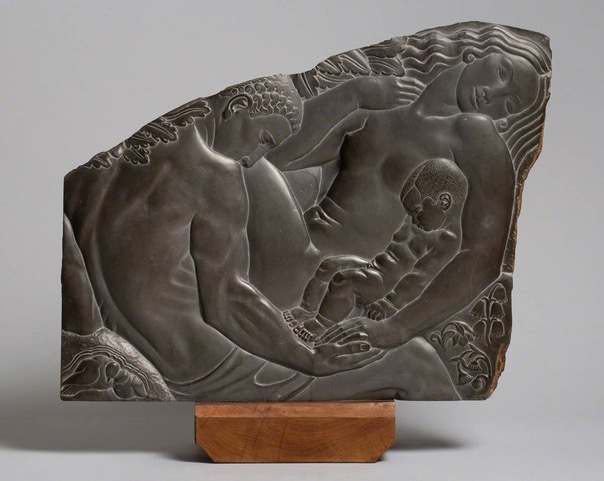
In the Aberdeen Art Gallery, set on a wooden pedestal, stands a large slab of stone which at first glance seems to have been recovered from some ruined structure or by archeological excavation. It features a pair of fascinating carvings in relief, one on each side, by the British sculptor and former president of the Royal Academy of Arts, Sir Charles Wheeler. Though sculpted in the 20th century, the form of the slab, the images depicted and the formal aspects of these images all offer rich possibilities for interpretation.
We approach the front of the work, that is, the side facing the open gallery floor, and we consider it the beginning of our ‘reading’, a Genesis. We see a man and a woman huddled together under a low canopy of oak leaves, and between them, a baby, resting on the cradle formed by the joined hands of mother and father. They are all asleep. In the bottom lefthand corner, two doves similarly lie with heads bowed together in sleep, and in the bottom righthand corner even the springtime blossoms hang in repose, and we recall the fitting title of the sculpture, Slumber. So far, the scene is edenic – humans and nature in harmony, the world is unfolding, perhaps about to wake from a primal sleep. But something threatens this sense of peace, gnawing at the edges of paradise.
We now look to the jagged sides of the slate – what appears once to have been a neatly finished rectangle or square has been damaged. What happened to so disfigure it? Did it decay and crumble with age? Or had it been violently dislodged from its original setting? The posture of the man now appears uncomfortable, as if he had narrowly avoided being broken off with the missing pieces of the slab. We are confronted with intimations of violence.
The date of the work adds another dimension to our interpretation: 1944. Scenes of destruction flash in the imagination. German bombings of southern England lasted until May of that year. Violence and danger are now well and truly part of the picture.
An article in Aberdeen Art Gallery’s “Sculpture of the Month” series points out that this “composition with its elegant and stylised linear patterns and strong outlines takes a backward glance at Art Deco, whilst embodying the lyrical, dreamy responses of neo-romantic art of the 1940s and early 1950s. It becomes a fragment from some lost civilisation.” And yet, despite seeming to belong to a forgotten world, the image is all too reminiscent of our own world. Life, delicate yet stubborn, unceasingly unfolds around us, miraculously, abundantly, but we cannot escape the sense that something has gone awfully wrong. We do not live undisturbed in paradise.
We walk around to the other side of the heavy slab.
Here, embedded into the ocher and amber-coloured stone surface is an image of a lion and a lamb in a slumber of their own. It is another relief but in contrast to the more modelled forms on the front which seem to emerge out of the stone, this one appears more like a fossil hidden inside the stone, as if had always been there, waiting to be discovered.
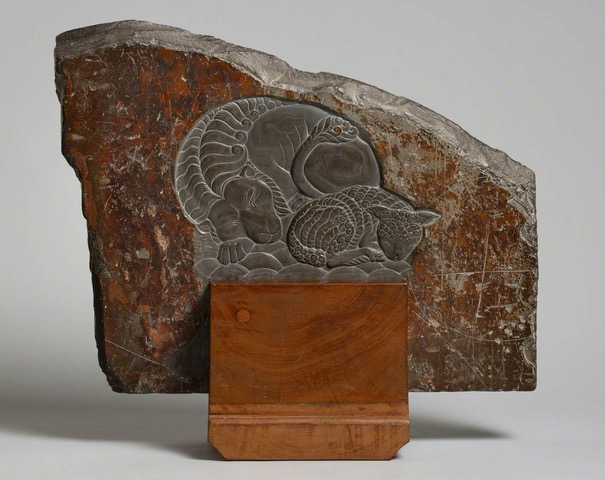
This image has an obvious biblical referent: Isaiah 11:6. "The wolf shall dwell with the lamb, and the leopard shall lie down with the young goat, and the calf and the lion and the fattened calf together.” It is a vision of the world made right.
This changes the status of the tablet from a broken fragment, something lost, to an unearthed fossil, something found. A deeper reality has surfaced. The fragile peace of the human family on the front relief – preserved in spite of the violence of their world – finds an echo in the even more ancient and yet more abiding peace that draws the lion and the lamb into final harmonious rest.
While we might look back at human history and think of all that has been squandered, and how creation and the soul of humanity is today continually being disfigured, this work speaks in a prophetic tone of a truth more deeply embedded than the undeniable evils we witness. And in its polar unity, Wheeler’s mysterious sculpture shows us something of the potential of art to hold together seeming contradictions in order to present a fuller truth.
It is difficult to know exactly what the artist intended with this sculpture. Surprisingly little has been written about it. But the message I hear is this: ultimate redemption lies deeper and endures longer than death and decay, despite appearances.
********
Charles Wheeler, Slumber, South African stone on oak pedestal, 71 cm x 92 cm x 7.5 cm.
Sir Charles Thomas Wheeler (1892-1974) was born just outside Wolverhampton and went to the city to attend the College of Art. He received a scholarship to the Royal College of Art in 1912. Wheeler worked mainly with bronze and stone. In perhaps his most famous architectural work, Wheeler designed the external sculptures for the Bank of England building in London, from 1928-37. He also created the fountain sculptures in Trafalgar Square, dedicated to Admiral Jellicoe. Other well-known public works include sculptures for Rhodes House, India House and South Africa House. He worked closely with the architect Herbert Baker on all of these projects, as he did with the Bank of England building. Throughout his career, Wheeler exhibited frequently at the Royal Academy of Arts, and in 1956 he became the first sculptor to hold the position of President of the Royal Academy. Source of biographical information: https://henry-moore.org/henry-moore-institute/research-library-and-archive/archive-of-sculptors-papers/archive-collections/charles-wheeler/
Otto Bam is editor of ArtWay.eu, arts project manager and fellow of The Kirby Laing Centre for Public Theology in Cambridge, and a doctoral student at King’s College London. His research focuses on the imagination and embodiment.